Tampa’s urban footprint grew on a coastal plain where Pleistocene sand terraces and interbedded clay lenses meet a shallow, fluctuating water table. The rapid development of Westshore and the Channel District during the 1990s and 2000s pushed geotechnical practice to confront loose-to-medium-dense sands that can compress, settle, and in extreme cases trigger cover-collapse sinkholes. Vibrocompaction design is not a one-size-fits-all exercise here; the proximity to Tampa Bay means the groundwater sits barely 4 to 8 feet below grade in many parcels, and that changes how vibratory energy propagates through the soil skeleton. A well-calibrated vibrocompaction plan does more than densify—it creates a predictable modulus of subgrade reaction, cuts post-construction settlement to under an inch, and gives the structural engineer a reliable bearing surface without resorting to deep foundations. For sites where the sand fraction is interrupted by silty pockets, we often cross-check the densification pattern with a CPT test so the tip resistance and sleeve friction confirm that target relative density has been achieved at every probe location.
In Tampa’s high-water-table sands, vibrocompaction acceptance isn’t just about blow counts — it’s about proving the post-treatment shear wave velocity meets the site-specific seismic demand.
Methodology applied in Tampa Florida
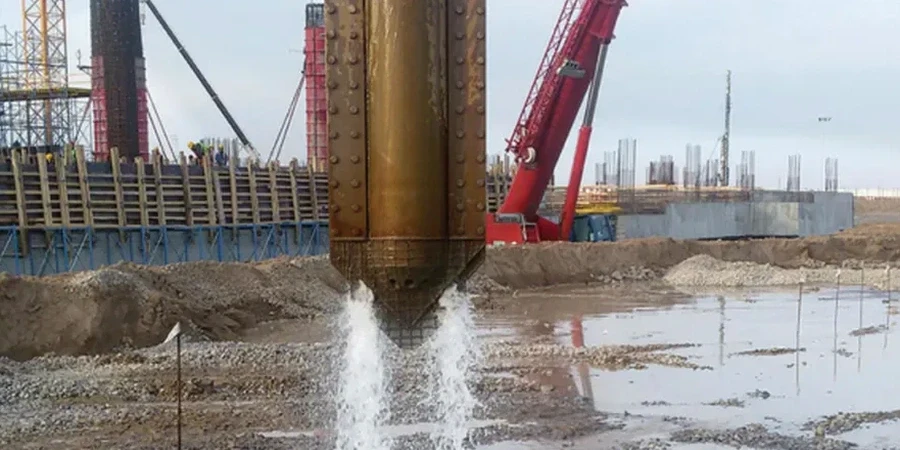
Local geotechnical conditions in Tampa Florida
On a typical Tampa vibrocompaction spread, the lead rig is a crawler-mounted hydraulic vibrator running a 15- to 20-inch diameter probe with eccentric weights that spin at 1200 to 2400 vibrations per minute. The crew watches the digital readout as the probe sinks under its own weight plus water jetting, then they pull it in controlled lifts while the ammeter shows the power draw dropping as the surrounding sand densifies. The biggest risk during design isn’t the equipment—it’s misreading the stratigraphy. A thin clay seam at elevation minus 18 feet, missed in a widely spaced boring program, can reflect vibratory energy and leave a loose shadow zone right where the stress bulb from the footing is deepest. That’s why the Tampa design approach leans heavily on pre-design SPT drilling logged at 2.5-foot intervals, so any low-blow-count lens appears before the compaction grid is finalized. Sinkhole proximity adds another layer: in the Gandy Boulevard corridor and parts of Town ’N Country, the design must specify a performance-based verification that no low-density pathways remain after treatment, because a single undensified sand column can become a raveling conduit over time.
Our services
Vibrocompaction design in Tampa Florida extends beyond grid layout and probe selection. The service package typically includes the following engineering components, tailored to the specific soil profile and project performance requirements.
Site-Specific Vibrocompaction Specification
Development of a complete ground improvement specification that defines probe type, grid geometry, withdrawal rate, dwell time, water-jetting pressure, and post-treatment acceptance criteria referenced to CPT tip resistance or SPT N-values. The spec is calibrated to the Tampa subsurface using available boring logs and laboratory index tests.
Pre- and Post-Treatment Verification Program
Design of a testing plan that positions CPT soundings or SPT borings at centroid and mid-side locations within the compaction grid, with frequency tied to the building footprint and the consequence class of the structure. The program includes pass/fail thresholds and a protocol for re-treatment of any zones that fall below the minimum relative density target.
Common questions
How much does vibrocompaction design cost for a project in Tampa?
For a typical commercial or mid-rise residential site in Tampa, the vibrocompaction design package ranges from US$1,430 to US$4,610, depending on the treated footprint, number of verification points, and whether the project requires a peer review for sinkhole-prone parcels. The fee covers the specification, the grid layout drawings, and the post-treatment compliance report.
What soil conditions in Tampa make vibrocompaction the right choice?
Vibrocompaction works best in the clean to slightly silty sands found across much of Tampa, particularly when the fines content stays below 12 to 15 percent. The method is ideal where the water table is within the treatment zone, because the submerged condition reduces effective stress and allows the vibratory energy to rearrange grains more efficiently. Sites with interbedded clay layers thicker than 18 inches or with significant organic content generally require a different ground improvement approach.
How is the design verified after the vibrocompaction is complete?
The design is verified through a combination of CPT soundings, SPT borings, and occasionally downhole shear-wave velocity measurements taken at the centroid and edges of the treatment grid. The acceptance criteria are written into the specification ahead of time, usually as a minimum cone tip resistance of 100 to 150 tsf or an SPT N-value above 25 to 30 blows per foot, depending on the depth and the design bearing pressure.
Does vibrocompaction design address Tampa’s sinkhole risk?
Vibrocompaction can reduce sinkhole risk in sandy profiles by densifying loose zones that could otherwise ravel upward. The design includes performance-based verification to confirm that no low-density pathways remain after treatment. However, for sites with known karst features or a history of cover-collapse sinkholes, the vibrocompaction scope is typically part of a broader mitigation strategy that may also include grouting or a reinforced mat foundation.