A 5-story mixed-use project on Kennedy Boulevard recently broke ground after our team flagged a 10-foot drop in the limestone bedrock across a diagonal of just 40 feet. Tampa’s subsurface doesn’t read textbooks—it alternates between stiff Hawthorn Group clays, loose surficial sands, and pinnacled Ocala Limestone that can destroy a uniform foundation design. A soil mechanics study here must map the vertical and lateral variability with far more resolution than a standard county report. We run a full laboratory program—triaxial shear on Shelby tube samples, one-dimensional consolidation for settlement-time curves, and Atterberg limits to classify the fat clays that swell in the summer humidity. For deep foundations, we cross-check SPT blow counts with unconfined compressive strength on rock cores, then model end-bearing and skin friction against the weathered rock interface. The output isn’t a generic bearing pressure: it’s a layer-by-layer profile with modulus values, Poisson ratios, and a differential settlement envelope that the structural engineer can load directly into their frame model. Where the site borders a mapped sinkhole feature—common north of Hillsborough Avenue—we integrate the resistivity survey to map void-prone zones before the drill rig even mobilizes.
A uniform bearing capacity across a Tampa site is geologically impossible—our soil mechanics study maps the differential parameters that the structural model actually needs.
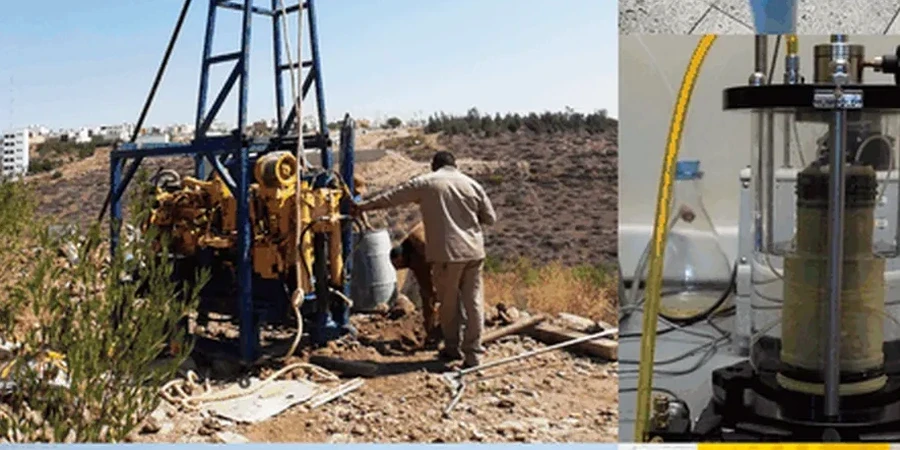
Methodology applied in Tampa Florida
Local geotechnical conditions in Tampa Florida
A site in South Tampa on a sandy ridge and a site in New Tampa over deeply weathered clay have almost nothing in common mechanically. South Tampa sands can densify under vibration—we’ve measured 30 percent relative density at 15 feet, which puts liquefaction on the table for a 500-year event. New Tampa’s stiff clays don’t liquefy, but they creep under sustained load, and the consolidation settlement can take 18 months to reach 90 percent completion. The costliest mistake we see is a uniform mat foundation placed across a pinnacled limestone surface: the slab spans between rock highs, the soil settles in the lows, and diagonal cracking appears within two years. A soil mechanics study with closely spaced borings—sometimes 30-foot centers in karst—maps the rock surface profile and lets the geotechnical engineer specify variable undercut depths, compacted fill lifts, or a transition to deep foundations where the rock drops below 40 feet. Missing that step in Tampa’s geology isn’t a code violation—it’s a structural failure waiting for the first heavy rainy season.
Our services
The laboratory program behind a Tampa soil mechanics study must address four distinct materials—loose quartz sand, stiff overconsolidated clay, soft organic silt, and vuggy limestone—each with its own failure mechanism. We configure the test suite to the stratigraphy logged in the field.
Triaxial Shear Strength
Consolidated-undrained tests with pore pressure transducers to define the Mohr-Coulomb envelope for bearing capacity and slope stability analysis in Tampa’s clay layers.
One-Dimensional Consolidation
Incremental oedometer tests measuring compression index Cc, recompression ratio Cr, and coefficient of consolidation cv for settlement-time prediction under fill and structural loads.
Rock Core Testing
Unconfined compression on NQ-diameter Ocala Limestone cores with RQD logging, unit weight, and modulus of elasticity for deep foundation design in pinnacled karst.
Index & Classification Tests
Atterberg limits, natural moisture content, grain-size distribution, and organic content per ASTM to classify Tampa’s Hawthorn Group clays and surficial sands for the geotechnical data report.
Common questions
What laboratory tests does a soil mechanics study in Tampa Florida require for foundation design?
The minimum program per IBC 2021 Chapter 18 includes Atterberg limits, grain-size distribution, natural moisture content, and unconfined compression or triaxial shear on undisturbed samples. For compressible clays we add one-dimensional consolidation to define settlement-time curves. If the boring log shows limestone within 50 feet, we run unconfined compression on rock cores and log the RQD. Seismic site class determination per ASCE 7-22 requires shear wave velocity measurement or correlation from SPT blow counts.
What is the typical cost range for a soil mechanics study in Tampa?
A comprehensive soil mechanics study with a drilling program, Shelby tube sampling, triaxial shear, consolidation, and rock core testing in Tampa typically runs between US$3,580 and US$4,480. The final figure depends on the number of borings, the depth to rock, and whether seismic parameters or swell testing are required by the structural engineer.
How long does it take to get the final soil mechanics report after drilling in Tampa?
Field drilling and sampling usually completes in 1 to 2 days per boring. Laboratory testing runs concurrently: triaxial tests need 7 to 10 days for saturation and shear phases, and consolidation tests require a minimum of 5 days for incremental loading. We typically deliver the geotechnical data report with all laboratory results, bearing capacity, and settlement analysis within 3 to 4 weeks of the drilling program.
Do you test for sinkhole risk as part of the soil mechanics study?
Yes—sinkhole risk assessment is integrated into the soil mechanics study for any Tampa site within a mapped karst terrain. We log the depth to rock refusal, record drilling fluid loss zones that indicate voids, and run electrical resistivity imaging to map low-resistivity anomalies. The report includes a sinkhole risk classification based on Florida Geological Survey criteria and recommends ground improvement or foundation mitigation if the raveling zone extends into the proposed bearing stratum.