A six-story mixed-use project on Kennedy Boulevard hit a layer of stiff Hawthorn clay at 18 feet. The structural engineer needed drained shear strength parameters to finalize the mat foundation design. We ran three consolidated-undrained triaxial tests with pore pressure measurement under ASTM D4767, delivering c' and φ' in five business days. The Tampa area presents a mix of surficial sands, porous Tampa Limestone, and overconsolidated clays of the Hawthorn Group, each requiring a different triaxial strategy. Understanding which test type applies to your stratum—and how to interpret the Mohr-Coulomb envelope for Florida’s variable geology—is what separates a usable report from a lab exercise. Our setup handles 2.8-inch Shelby tube specimens and reconstituted samples compacted to field density for footings design verification.
Triaxial strength is not a single number—it’s the Mohr-Coulomb envelope your structural engineer needs for bearing capacity and slope stability in Tampa’s layered geology.
Methodology applied in Tampa Florida
Local geotechnical conditions in Tampa Florida
The Florida Building Code references ASCE 7 and requires site-specific geotechnical parameters for structures in Seismic Design Category B and above, which includes much of Tampa due to the deeper basement rock response. Triaxial testing is not optional when designing deep foundations in the Hawthorn Group—overestimating undrained shear strength by relying solely on SPT correlations can lead to pile length shortfalls. We have seen projects in the Ybor City area where clay sensitivity was higher than expected, and only a CU triaxial with pore pressure measurement caught the strain-softening behavior. Skipping this test or running the wrong type puts the foundation at risk of bearing failure or excessive differential settlement. The IBC explicitly permits triaxial-derived strength for bearing capacity calculations, but only when test conditions replicate field drainage. For Tampa’s fluctuating water table, that means consolidated-undrained testing with pore pressure data is the minimum defensible standard.
Our services
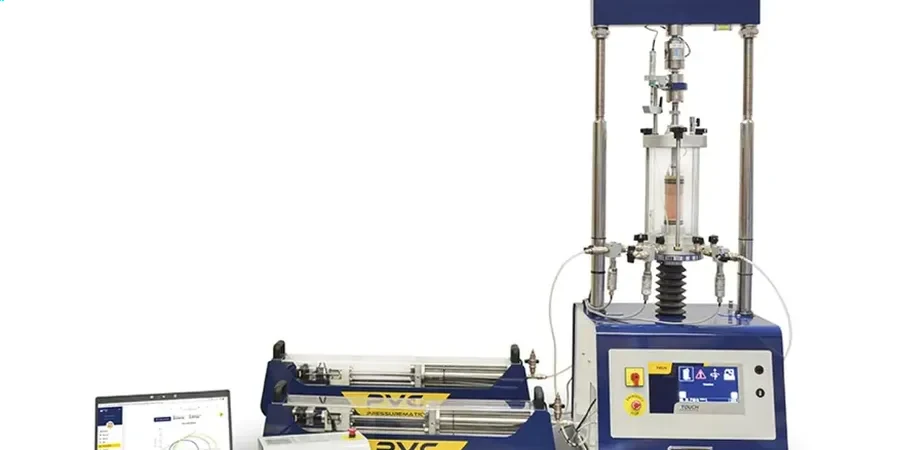
Our Tampa triaxial lab runs three test configurations, each suited to a specific drainage condition and project timeline.
Consolidated-Undrained (CU) with Pore Pressure
The standard for effective stress analysis in Tampa’s saturated clays. We measure pore pressure during shear to calculate c’ and φ’. Turnaround is five to seven business days.
Unconsolidated-Undrained (UU) Quick Test
Used for short-term loading on low-permeability soils. We run three specimens at different confining pressures and deliver total stress parameters within three business days.
Consolidated-Drained (CD) with Volume Change
Required for long-term drained analysis of Tampa Limestone and clean sands. Test duration is seven to ten days due to the low strain rate needed for full drainage.
Common questions
What does a triaxial test cost in Tampa?
A standard three-specimen triaxial test in Tampa runs between US$2,100 and US$2,820, depending on the test type. A CU with pore pressure measurement is at the higher end; a UU quick test is at the lower end. Expedited turnaround adds a surcharge.
Which triaxial type do I need for Hawthorn Group clay?
Consolidated-undrained with pore pressure measurement (ASTM D4767). The Hawthorn clay is overconsolidated and can be strain-softening. CU testing captures both drained and undrained strength envelopes, which are essential for foundation design in Hillsborough County.
How long until I get the test report?
UU tests are reported in three business days. CU tests take five to seven business days. CD tests on limestone can take up to ten business days. We send preliminary c’ and φ’ values as soon as the last specimen shears, ahead of the final report.
Can you test Tampa Limestone in triaxial compression?
Yes, but it requires a drained test at a very slow strain rate to prevent pore pressure buildup in the carbonate matrix. We trim specimens carefully because the limestone can contain fossil fragments. The test yields both peak and residual strength parameters.