Tampa sits on a geological mosaic of Pleistocene sands, silts, and the underlying Hawthorne Group limestones. Much of the city's commercial expansion—Westshore, New Tampa, even the infill along Bayshore Boulevard—is built on soils that shift between well-draining Myakka fine sand and pockets of organic clay. Getting the compaction right here is not just a specification checkbox; it is the difference between a pavement that lasts a decade and one that cracks after the first rainy season. We run the sand cone test strictly under ASTM D1556, correlating field density with lab maximums from modified Proctor curves. For projects near the Hillsborough River floodplain, where groundwater tables sit barely 4 to 6 feet down, we often pair the density results with a deeper in-situ permeability survey to ensure the subgrade will not degrade from capillary rise during summer storms.
In Florida's sandy terrain, a single percentage point drop in field compaction can mean decades of premature settlement—the sand cone method remains the most honest QA tool we have.
Methodology applied in Tampa Florida
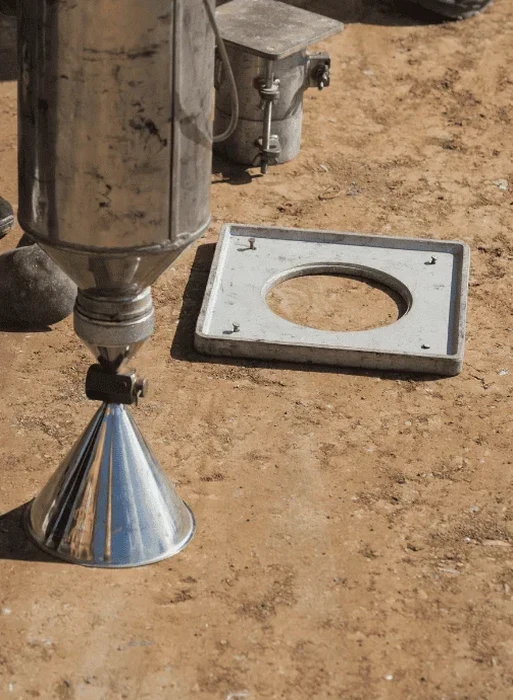
Local geotechnical conditions in Tampa Florida
The Florida Building Code, referencing ASCE 7-22 and IBC Chapter 18, mandates compaction verification for structural fill and pavement subgrades in a region where sinkhole activity and differential settlement are documented risks. Tampa's karst geology means that poorly compacted utility trench backfill is a recurring failure point—voids propagate upward from limestone fissures, and loose soil simply collapses. The sand cone method gives the geotechnical engineer a direct measurement of in-place dry density, which is irreplaceable when evaluating whether a contractor's lift thickness truly met the 95 percent modified Proctor threshold. Relying solely on nuclear gauge correlations without sand cone calibration in Florida's variable soils is a gamble that has led to expensive rework on FDOT-funded projects. We see it every year on I-275 corridor widenings where sandy clay subgrades were assumed uniform but were not.
Our services
Our Tampa field and lab crews integrate the sand cone test within a broader QA/QC program designed to meet both private development and FDOT specifications. The services below reflect the most common requests we receive from geotechnical consultants and earthwork contractors across the Bay area.
Compaction verification for building pads
ASTM D1556 testing at footing subgrade elevations, with immediate pass/fail reporting relative to project-specific Proctor curves. We coordinate directly with your superintendents to minimize downtime.
Utility trench backfill QA
Inspection of pipe zone and backfill lifts in accordance with City of Tampa Public Works standards, including moisture conditioning recommendations when sands are too dry for optimum compaction.
Roadway subgrade and base course testing
Density profiles across limerock and asphalt base layers, with sand cone calibration checks against nuclear density gauges. Aligned with FDOT Section 120 specification requirements.
Laboratory Proctor correlation
Modified Proctor (ASTM D1557) and one-point Proctor verification runs in our ISO 17025-accredited lab, ensuring the field density reference is always representative of the actual material placed.
Common questions
How deep can the sand cone test go in Tampa's sandy soils?
The method works best for lift thicknesses between 4 and 8 inches. In Tampa's typical fine sands and sandy clays, we can excavate a clean test hole up to about 10 inches without sidewall collapse. For deeper density profiling—say, a 24-inch compacted fill beneath a mat foundation—we test incrementally, one lift at a time, to keep the data reliable.
What does a field density test cost in the Tampa Bay area?
For a standard sand cone test with immediate field reporting and lab moisture correlation, budget between US$110 and US$130 per test point. Volume pricing applies when we are running multiple points on the same site, which is common for roadway and large pad projects.
How does the sand cone method compare to a nuclear gauge in our local soils?
The sand cone test is a direct measurement of density—you excavate, weigh the soil, and measure the hole volume. Nuclear gauges are indirect and can drift in Florida's humid, organic-rich soils. We consider the sand cone the referee method; on FDOT projects, we calibrate nuclear gauges against sand cone results at the start of each job to correct for local mineralogy and moisture interference.
Can you test density in limerock or crushed concrete base under Tampa's summer rain conditions?
Yes, with some practical adjustments. Limerock and recycled concrete bases are common here. We use a larger base plate and a coarser calibration sand if the aggregate is open-graded. During Tampa's afternoon thunderstorms, we schedule tests early in the day or protect the test area with a canopy—standing water in the test hole invalidates the volume measurement, so dry conditions are essential for an accurate result.