The Florida Building Code and ASTM D2488 establish the standard of care for subsurface exploration, yet Tampa's unique geology demands more than a checklist approach. The city sits on a karst-influenced terrain where the Hawthorn Group clays transition into weathered limestone, and surficial sands blanket much of the interbay peninsula. An exploratory test pit executed per ASTM D2487 logging protocols allows direct observation of bedding, moisture conditions, and karst features that boreholes often miss. Our team has opened test pits in Ybor City's urban fill, along the Hillsborough River floodplain, and throughout Westshore's redevelopment corridors, giving us a granular understanding of how Tampa's stratigraphy varies block by block. When a standard boring raises questions about boulders, debris, or limestone pinnacles, we mobilize within 48 hours to excavate and log the exposure, often pairing the visual data with a CPT test for continuous profiling where sands control settlement behavior.
Direct visual logging of a test pit wall reveals limestone pinnacles and solution cavities that rotary borings routinely deflect around.
Methodology applied in Tampa Florida
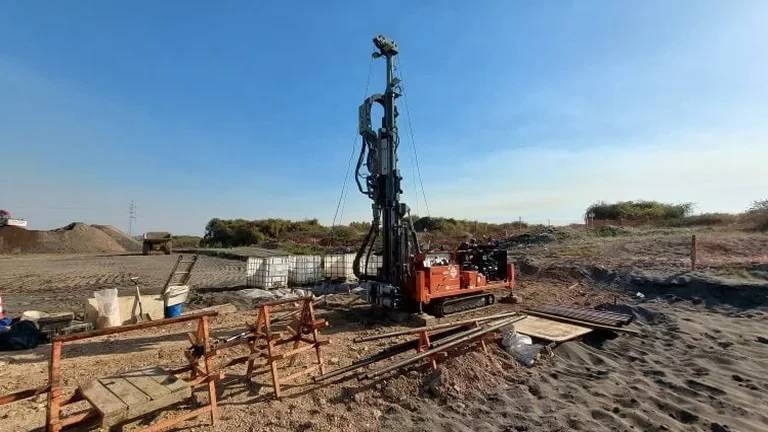
Local geotechnical conditions in Tampa Florida
We excavated a site near the Courtney Campbell Causeway where the geotechnical report assumed continuous limestone at minus eight feet based on three borings. The test pit revealed a two-foot-wide solution pipe filled with organic silt and decaying vegetation that extended past twelve feet—a collapse hazard no rotary rig would flag. In Tampa's karst environment, relying solely on SPT data means accepting that a 30-inch split spoon can glance off a pinnacle and misrepresent the rock surface by several feet. The consequence shows up during foundation construction when one caisson hits refusal at elevation and the adjacent one drops six feet into a clay-filled void. An exploratory test pit opens a window large enough to see these features in context, and when we suspect interconnected voids we recommend supplementing with stone columns as a ground improvement strategy before structural loads are applied. The cost of a day's excavation is negligible against the change order that follows an undetected karst feature.
Our services
Our Tampa test pit program includes several layers of technical support beyond the excavation itself:
Karst Feature Documentation
Pit-wall mapping of solution cavities, clay seams, and pinnacle relief with scaled photography and GPS-tagged stationing for integration into the geotechnical baseline report.
Urban Utility Clearance Package
Sunshine 811 ticket management, private utility locating, and Tampa Water Department clearance coordination so excavation proceeds without hitting a force main or fiber trunk.
Common questions
How deep can you excavate a test pit in Tampa's sandy soils?
With our extended-reach excavator we routinely reach 16 to 18 feet in stable ground, but depth in loose surficial sands depends on groundwater elevation. When the water table sits at minus five feet, as it often does in South Tampa during summer months, we bench the excavation wider and may limit depth to 12 feet to maintain safe working conditions per OSHA Subpart P.
What does an exploratory test pit cost in the Tampa Bay area?
For a standard test pit in accessible terrain with typical depth of 8 to 14 feet, including mobilization, excavation, visual logging per ASTM D2488, bulk sampling, and backfill, the range runs from US$430 to US$960. Sites requiring traffic control on arterial roads like Dale Mabry Highway or near MacDill AFB approach the upper end due to lane closure permits and flagger requirements.
Can a test pit identify sinkhole activity better than a boring?
Yes, and this is the primary reason we recommend them in Tampa. A boring produces a one-inch-diameter record that can miss raveling zones, clay-filled pipes, and dome cavities entirely. A test pit exposes a continuous vertical face several feet wide, so the geologist can trace the boundaries of a raveling zone and measure the dip of limestone pinnacles directly.
How do you handle groundwater in an open test pit excavation?
We schedule pits for the dry season when possible, but year-round we carry a trash pump capable of 150 gpm for dewatering. In locations with high transmissivity sands, like the Interbay peninsula, we may install a small sump at the pit toe and pump discharge to a sediment bag or permitted discharge point per Hillsborough County EPC requirements.