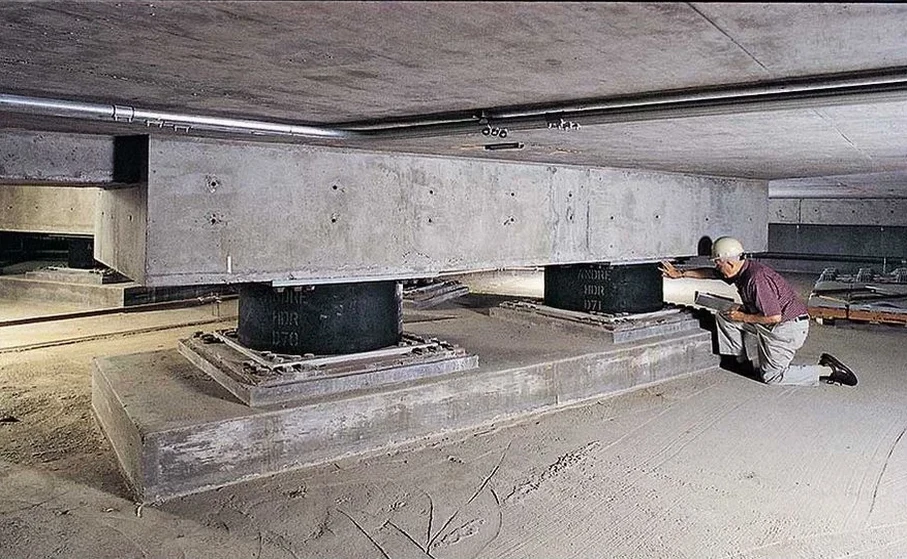
In Tampa, the real seismic challenge isn't just the occasional tremor from the Caribbean plate—it's how those waves interact with Florida's limestone foundation. Most engineers working along the I-4 corridor know that the Hawthorn Group sediments under Tampa can amplify ground motion in ways the standard ASCE 7 maps don't fully capture. We've noticed this on sites near the Hillsborough River where soft organic lenses sit above pinnacled rock. Base isolation seismic design shifts the equation entirely, decoupling the structure from ground acceleration instead of fighting it with brute stiffness. The approach requires careful site-specific response spectra, which we develop using borehole data tied to seismic refraction profiles that map the top of rock with precision. In karst terrain like ours, that rock surface is rarely flat, and the isolation system's performance depends on knowing exactly what's underneath. We also draw on CPT testing in the sandy overburden common to Westshore and downtown Tampa to characterize soil damping and modulus degradation curves, feeding directly into the nonlinear time-history models that govern isolator selection.
In Tampa's karst landscape, base isolation isn't just about reducing spectral acceleration—it's about preventing differential settlement from turning a seismic joint into a structural hinge.
Methodology applied in Tampa Florida
Local geotechnical conditions in Tampa Florida
A 15-story residential tower going up on Bayshore Boulevard hits refusal at 90 feet on limestone—but the rock surface is a karst minefield with 20-foot vertical pipes filled with soft clay. The structural team designs a friction pendulum isolation system assuming a rigid base at the pile caps. Six months later, differential settlement across the footprint reaches 1.5 inches because the clay-filled cavities are consolidating under the new load, and the isolation bearings are now out of plane by a fraction of a degree. That misalignment changes the effective radius of the slider, shifts the isolation period, and introduces unanticipated torsional response. We've seen this scenario play out in Tampa more than once. The fix is never cheap. Our approach ties the geotechnical model directly into the isolation design loop—we model the foundation flexibility explicitly using impedance functions derived from crosshole geophysics, not just a generic fixed-base assumption. When sinkhole risk is present, which it is across most of Tampa's peninsula, we integrate grouting programs to stabilize the rockhead before the isolators are even specified. Skipping that step puts the whole isolation strategy at risk.
Our services
Our base isolation design package in Tampa covers the full workflow from subsurface characterization through peer review. Each component is calibrated to the ASCE 7 risk-targeted framework and Florida's specific geological conditions.
Ground motion characterization & site response
We develop site-specific response spectra using Vs profiles from downhole or crosshole methods, accounting for Tampa's limestone impedance contrasts and potential basin-edge effects near the Gulf coastline.
Isolation system modeling & nonlinear time-history analysis
Full 3D superstructure-isolation-foundation models with lead-rubber or friction pendulum elements, subjected to spectrum-matched ground motion suites per ASCE 7 Chapter 16 requirements.
Foundation flexibility & soil-structure interaction integration
Explicit modeling of pile group or mat foundation stiffness under the isolation plane, including karst irregularity effects and long-term settlement reconciliation with seismic displacement demands.
Common questions
What does base isolation seismic design cost for a mid-rise building in Tampa?
For a typical 5- to 10-story structure in the Tampa area, the full design package—including site-specific ground motion analysis, nonlinear modeling, bearing specification, and peer review coordination—runs between US$4,620 and US$9,140 depending on structural complexity and the number of ground motion suites required. Projects with significant karst investigation or soil-structure interaction modeling fall toward the upper end.
Does the Florida Building Code require base isolation for certain structures?
The Florida Building Code doesn't mandate base isolation outright, but it references ASCE 7 risk category and drift limits that often make isolation the most practical solution for essential facilities and high-rise construction in Site Class D or E conditions like those found across Tampa.
How do Tampa's sinkhole conditions affect the performance of isolation bearings?
Karst dissolution features create irregular bedrock surfaces and potential void collapse zones under load. Even small differential settlements can tilt bearings out of their design plane, altering the slider radius in friction pendulums or introducing shear strains in elastomeric bearings that weren't accounted for. We model foundation flexibility explicitly and often recommend pre-construction grouting to stabilize the rockhead before isolator installation.
What's the difference between lead-rubber bearings and friction pendulum systems for Tampa geology?
Lead-rubber bearings (LRBs) provide hysteretic damping through a lead core and work well when you need recentering force built into the bearing. Friction pendulum systems (FPS) use the structure's weight sliding on a curved surface to achieve the same isolation period. In Tampa, the choice often comes down to uplift restraint needs—FPS handles tension poorly—and how much vertical stiffness you can afford when working over potentially irregular karst rock.
How long does the base isolation design process take?
A complete design cycle for a Tampa project—from initial geophysical surveys through final bearing shop drawings—typically spans 8 to 14 weeks. The subsurface investigation phase is often the pacing item, especially when karst mapping with seismic refraction or crosshole testing reveals complex rockhead geometry that requires additional boreholes or grouting design iterations.