Tampa’s subsurface is a story written by ancient shorelines, where loose sands and weathered limestone sit atop a deeply weathered karst platform. The Florida peninsula isn’t known for high-magnitude earthquakes, but site amplification in soft, moist soils can still surprise engineers who skip the VS30 profile. We run active-source MASW surveys across Hillsborough County to capture shear wave velocity down to 30 meters, the exact parameter ASCE 7 requires for seismic site class determination. Because Tampa’s water table often sits within two to three meters of the surface, near-surface saturation skews traditional borehole velocity measurements — yet surface-wave methods cut through that ambiguity cleanly. When a developer near the Port of Tampa Bay needs a Site Class D or E confirmation before finalizing foundation design, we mobilize a 24-channel seismograph and lay out a geophone spread that fits tight urban lots as easily as large greenfield parcels. The resulting dispersion curve gets inverted into a 1D VS profile that feeds directly into the structural engineer’s ground motion analysis, and because we process data in-house under ISO 17025 protocols, the turnaround from field acquisition to signed report rarely exceeds four business days. For deeper stratigraphic context on sites where sinkhole activity is suspected, combining MASW with a seismic refraction survey helps distinguish velocity inversions that a single method might misinterpret as competent rock.
In Tampa's saturated near-surface sands, a properly acquired VS30 profile often reveals Site Class D where default assumptions would conservatively push a project into Class E.
Methodology applied in Tampa Florida
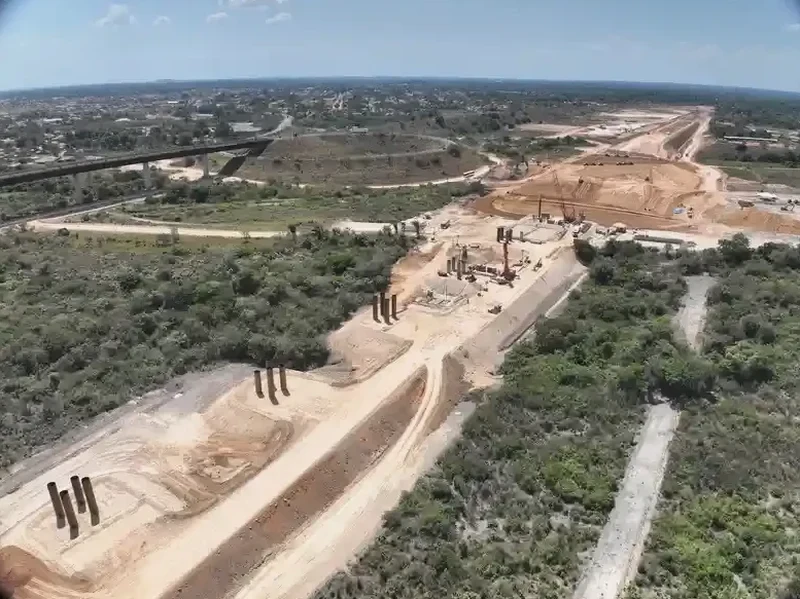
Local geotechnical conditions in Tampa Florida
We bring a Geometrics Geode seismograph and a string of 4.5 Hz geophones that connect over takeout cables spanning up to 92 meters — which means we need a clear linear corridor roughly the length of a basketball court plus buffer. On cramped Tampa infill lots, like those in Seminole Heights or along Dale Mabry Highway, that isn't always available without creative array geometry, and we've learned to work with angled spreads or roadside easements when straight lines aren't feasible. The bigger operational risk is Tampa's afternoon thunderstorm cycle from June through September: lightning within 10 kilometers forces crew shutdown, and saturated ground coupling can introduce low-frequency noise that muddies the dispersion curve below 8 Hz. We mitigate this by scheduling data acquisition for early morning windows when atmospheric and cultural noise are both at their minimum. A less obvious but equally real consequence of skipping VS30 measurement in Tampa involves the hidden amplification potential of loose surficial sands overlying solution-weathered limestone — a velocity contrast that standard SPT-based site classification methods routinely miss, leaving seismic design forces underestimated and foundation performance at risk during the rare but possible Atlantic margin earthquake.
Our services
Our Tampa MASW program covers the full workflow from site walk to final seismic classification, with variants tuned to project size and depth requirements.
Active-Source MASW (VS30)
Standard 24- or 48-channel survey with sledgehammer source, processed to deliver IBC-compliant VS30 values and Site Class A-F determination for structures up to 160 ft in height.
Passive-Source MASW (Deep VS Profiling)
Microtremor array technique using ambient noise for depth penetration beyond 50 m, applied when Tampa's limestone interface is deeper than expected or when deep basin effects require characterization.
Combined MASW + Refraction Tomography
Simultaneous P-wave and S-wave acquisition for sites near known sinkhole zones or abandoned phosphate mines, where velocity anomalies need both compressional and shear wave imaging to resolve geometry.
Common questions
How much does a MASW / VS30 survey cost for a typical Tampa commercial lot?
For a standard active-source MASW survey on a commercial lot within Hillsborough County, our fees range from US$1,920 to US$3,250, depending on array length, number of shot points, and whether passive-source supplementation is needed for deeper profiling. Sites with limited line-of-sight or those requiring after-hours access near active roadways fall toward the upper end. Every quote includes field acquisition, dispersion analysis with uncertainty bounds, VS30 calculation per IBC 2021, and a signed PDF report.
Is MASW accepted by Tampa building departments for seismic site classification?
Yes. The IBC 2021 explicitly permits shear wave velocity measurements — including surface-wave methods like MASW — as the preferred basis for determining Site Class under Section 1613. Tampa's building officials and most geotechnical review boards accept MASW-derived VS30 profiles provided the report documents array geometry, dispersion curve quality metrics, and inversion methodology consistent with FHWA and ASTM D7400 guidelines.
How long does it take to get results from a MASW survey in Tampa?
Fieldwork on a standard lot takes four to six hours, including array layout, multiple shot records, and demobilization. Data processing runs one to two days in our Tampa office, and we deliver the final VS30 report with site classification within three to four business days after acquisition. Rush turnaround within 48 hours is available when foundation design schedules can't wait.