Tampa's geotechnical profile is deceptive. The surface sand fools a lot of contractors. Just a few feet down you often hit silty layers or high-plasticity clay pockets that completely change drainage and bearing behavior. That is where a full grain size analysis (sieve + hydrometer) becomes essential. You need the complete particle distribution curve. Not just the sand fraction. The hydrometer captures the silt and clay passing the #200 sieve. Those fines control permeability and shrink-swell potential. Without them, you are designing blind. We run the full ASTM D422 procedure in our accredited lab. From coarse sand down to colloidal clay. The resulting curve connects directly to USCS classification per ASTM D2487. For Tampa engineers dealing with stormwater infiltration, foundation subgrades, or liquefaction assessments, the hydrometer data is non-negotiable.
The hydrometer captures what the sieves miss. In Tampa's layered coastal sediments, that fine fraction is often the difference between a viable design and a failed subgrade.
Methodology applied in Tampa Florida
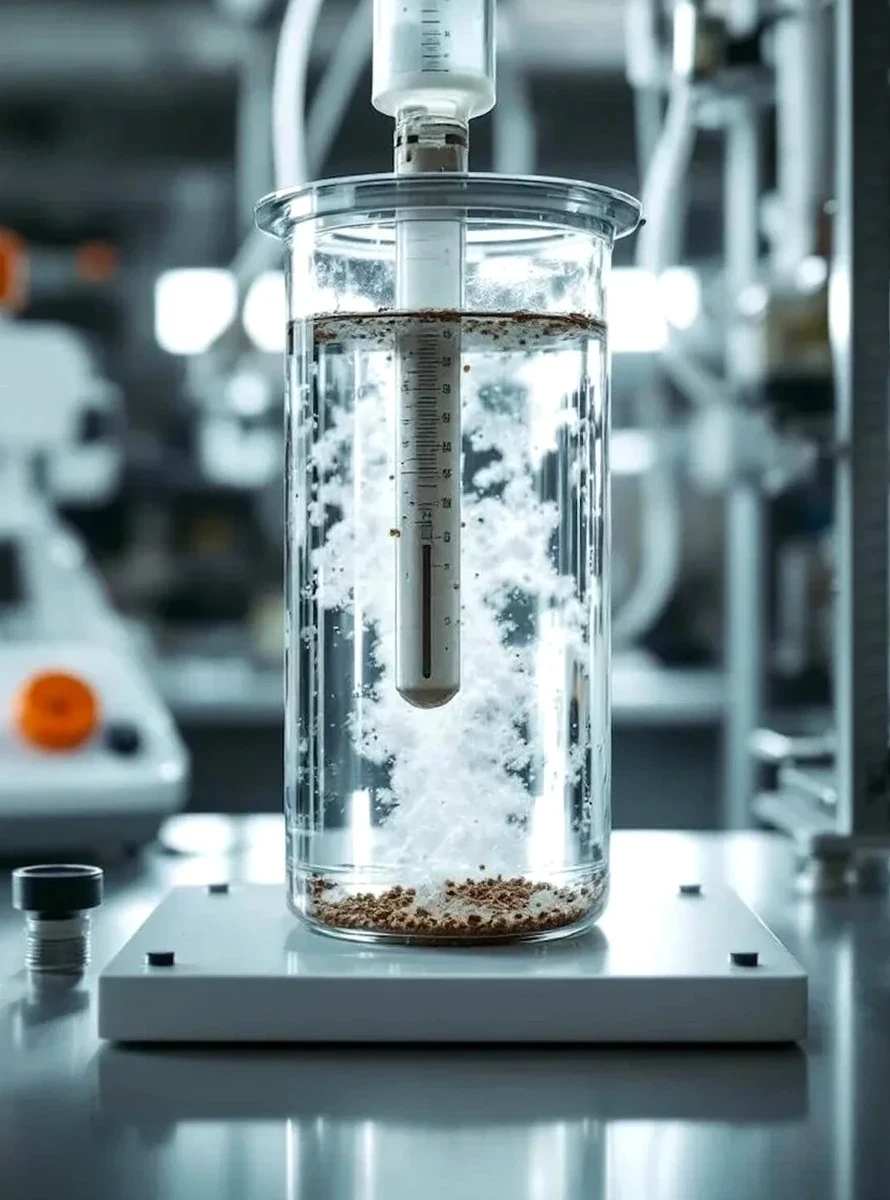
Local geotechnical conditions in Tampa Florida
The hydrometer sedimentation cylinder sits in a temperature-controlled bath at exactly 20°C. That stability matters. A one-degree drift in Tampa's ambient heat shifts the density reading and skews your clay fraction. We run readings at 0.5, 1, 2, 4, 8, 15, 30, 60, 120, 240, and 1440 minutes. Each reading converts via Stokes' Law to an equivalent particle diameter. If the technician shortens the settling time or skips the meniscus correction, the percent clay gets underreported. That underreporting is dangerous. It masks expansive potential. It inflates permeability estimates. For stormwater basins and infiltration trenches in Hillsborough County, that error causes premature clogging. We run duplicate hydrometer tests on every sample with more than 12% passing the #200 sieve. No shortcuts on fine-grained soils.
Our services
We provide two levels of grain size analysis depending on project requirements and material type:
Full Sieve + Hydrometer Package
Complete ASTM D422/D7928 analysis. Mechanical sieving from 3 inches to #200, followed by hydrometer sedimentation on the minus #200 fraction. Includes USCS classification per ASTM D2487, gradation plot, and coefficients of uniformity and curvature. Standard 5-day turnaround.
Wash Sieve Only (Coarse Fraction)
For clean sands and gravels with minimal fines. Sieve analysis through #200 with water wash. Reports percent retained on each sieve, percent passing #200, and gradation curve. Suitable for concrete aggregate qualification and drainage media specification.
Common questions
Why does Tampa soil need hydrometer testing and not just sieves?
Tampa's geology includes significant silt and clay layers within the Hawthorn Group and surficial deposits. Sieves alone stop at the #200 mesh (0.075 mm). The hydrometer quantifies the silt (0.075–0.005 mm) and clay (<0.005 mm) fractions. Those fines control shrink-swell behavior, permeability, and frost susceptibility even in Florida's climate. Without hydrometer data, you cannot assign a correct USCS group symbol for fine-grained soils.
How much does a grain size analysis cost in Tampa?
A full sieve plus hydrometer analysis typically runs between US$90 and US$200 per sample, depending on whether you need standard 5-day turnaround or expedited 48-hour processing. The wash sieve-only option falls at the lower end of that range. Volume discounts apply for projects with ten or more samples.
What sample mass do you need for a complete grain size test?
We require at least 500 grams of oven-dried material for sandy soils, or 200 grams for silts and clays. The sample must be representative of the stratum. We can split bulk samples in our lab using ASTM C702 procedures. For Shelby tube samples, the entire tube segment works best. Avoid bagged samples that have dried out completely—rehydration changes the natural gradation.
How do I interpret the D10, D30, D60 values on the report?
D10 is the particle diameter at 10% passing by weight—it is the effective grain size used in permeability formulas like Hazen's equation. D30 and D60 are diameters at 30% and 60% passing. The ratio D60/D10 gives the coefficient of uniformity (Cu). The ratio (D30)²/(D10×D60) gives the coefficient of curvature (Cc). For well-graded sands, Cu > 6 and 1 < Cc < 3. For well-graded gravels, Cu > 4. Our reports calculate both coefficients and include the USCS classification.