Tampa’s geology doesn’t read like a textbook—it’s a patchwork of ancient dune sands, buried organic silts, and the unpredictable limestone of the Hawthorne Group. Designing a shallow foundation here means confronting a water table that can sit barely three feet below the slab during summer storms, when the city gets over 7 inches of rain in a single month. In our experience, a footing that works perfectly in Carrollwood may need complete rethinking half a mile south, where the sandy soil transitions into soft, highly compressible muck from an old cypress dome. We’ve learned to pair every bearing capacity check with a rigorous differential settlement analysis, because the real threat in Tampa isn’t total failure—it’s the slow, uneven tilting that cracks block walls and binds doors. A thorough site investigation often starts with standard penetration testing to map refusal depth on the limestone, which can vary from 8 to 40 feet across a single lot. Our designs use this stratigraphy to size footings that bridge soft spots without over-excavating into the aquifer, keeping the foundation stable through Tampa’s dramatic wet-dry cycles.
Tampa’s limestone karst doesn’t announce itself until you hit a void at 12 feet—our designs account for that uncertainty from the first borehole.
Methodology applied in Tampa Florida
Demonstration video
Local geotechnical conditions in Tampa Florida
Tampa’s post-war boom pushed subdivisions into low-lying terrain that earlier generations had wisely left as marsh and pine flatwoods. Those filled areas, compacted with whatever was available in the 1950s, now underlie thousands of aging homes and commercial strips from West Tampa to Temple Terrace. The buried organics in these fills continue to decompose, creating voids and differential settlement decades after construction. We’ve opened test pits where the fill layer contained tree stumps, asphalt chunks, and construction debris—none of which provides uniform support for a shallow footing. On top of that, Florida’s sinkhole insurance crisis, triggered by the catastrophic events in nearby Seffner, has made geotechnical due diligence a non-negotiable part of any Tampa property transaction. Our designs always include a karst hazard assessment that maps the depth to competent limestone and identifies zones where a raveling failure could propagate to the surface. When we find soft zones deeper than the footing influence zone, we recommend the vibrocompaction technique to densify the sand column before placing the foundation, eliminating the risk of sudden collapse from a deep-seated void migration.
Our services
Our shallow foundation design process in Tampa is built around three integrated phases—from subsurface investigation through final bearing capacity verification—each calibrated to the specific karst and coastal conditions of the Tampa Bay area.
Geotechnical Site Investigation
We execute SPT borings, Shelby tube sampling, and test pits to map Tampa’s variable stratigraphy. Lab testing includes Atterberg limits, grain size distribution per ASTM D2487, and unconfined compressive strength on limestone cores to establish bearing capacity and settlement parameters for each footing location.
Bearing Capacity and Settlement Analysis
Using Terzaghi and Meyerhof bearing capacity equations modified for layered soil profiles, we compute allowable bearing pressures with a factor of safety of 3.0 against shear failure. Settlement calculations follow elastic half-space and consolidation theory, with time-rate estimates for the silty sands common in Hillsborough County.
Foundation Design and Construction Specifications
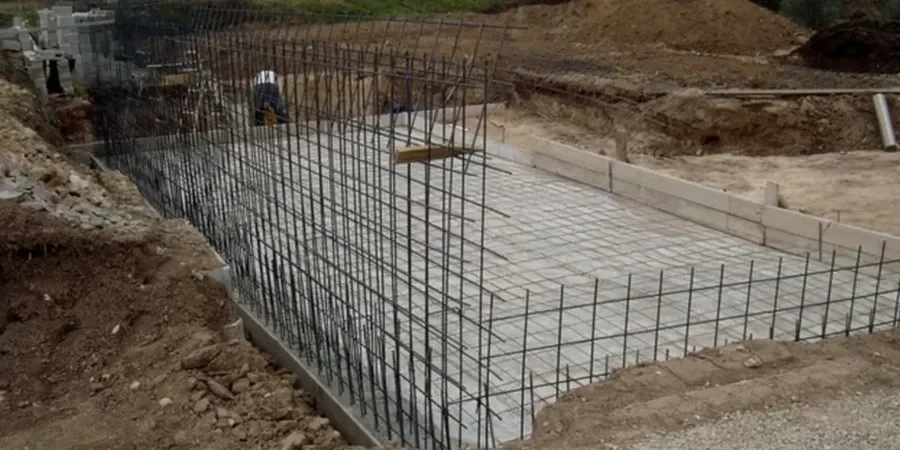
We deliver dimensioned footing plans, reinforcement schedules, and subgrade preparation specs that address Tampa’s high water table—including dewatering protocols, vapor barrier placement, and capillary break layers. Every design package includes a statement of special inspections required under IBC Chapter 17.
Common questions
What bearing capacity can I expect for a shallow foundation in Tampa?
It depends entirely on the soil at your specific lot, but in the dense sands over limestone that dominate much of South Tampa and the Interbay peninsula, we typically design for allowable bearing pressures between 2,500 and 4,000 psf. In areas with looser silty sands, like parts of New Tampa or near the Hillsborough River, values may drop to 1,500–2,000 psf. We never use a single presumptive number—our designs are based on SPT N-values and lab strength data from borings on your parcel.
How do you handle Tampa's high water table in foundation design?
A shallow water table, often within 3 feet of grade during summer, affects both bearing capacity and constructability. We specify a clean graded aggregate capillary break beneath the slab to prevent moisture wicking, and we design footing depths to keep the bearing surface above the seasonally saturated zone where possible. For deeper excavations, we outline dewatering requirements—usually well-point systems—to keep the excavation dry during concrete placement and curing.
What's the typical cost range for shallow foundation design on a residential project in Tampa?
For a single-family residential project in Tampa, the geotechnical investigation and shallow foundation design package generally falls between US$1,870 and US$3,360, depending on the number of borings required, access constraints, and whether a karst hazard assessment is included. Commercial and multi-story projects run higher due to deeper investigation requirements and more extensive analysis.
Is sinkhole investigation required for shallow foundations in Hillsborough County?
Under Florida Statute 627.706, sinkhole investigations are mandated for insurance purposes in many cases, but the geotechnical requirements for foundation design go beyond that. Even without a visible sinkhole, we evaluate the limestone surface with borings to a minimum of 20 feet below grade, checking for raveling zones and soft clay seams that could indicate an active subsidence feature. This is standard practice for any shallow foundation we design in Tampa, not just in mapped sinkhole zones.