The loading press hums steadily in the lab, its piston pushing a standard plunger into a compacted soil sample at exactly 0.05 inches per minute. That slow, controlled penetration is the heart of every soaked CBR specimen we run for Tampa projects. Our team prepares remolded samples at the optimum moisture and density from your field material, then submerges them in water for 96 hours to simulate the worst-case saturation Florida subgrades face after a summer thunderstorm or hurricane season. The dial gauges and load ring readings translate directly into a bearing ratio number that tells the pavement engineer whether the native sandy soil, limerock base, or stabilized layer has enough structural capacity to support traffic loads without rutting. In the Tampa Bay area, where shallow groundwater and frequent rainfall keep subgrades perpetually moist, soaked CBR values often control the pavement design more than dry-season strengths. Flexible pavement thickness design relies directly on these lab-measured bearing ratios to meet FDOT specifications and local county requirements.
A 96-hour soaked CBR on Tampa's sandy subgrade tells you more about real pavement performance than any dry-strength index.
Methodology applied in Tampa Florida
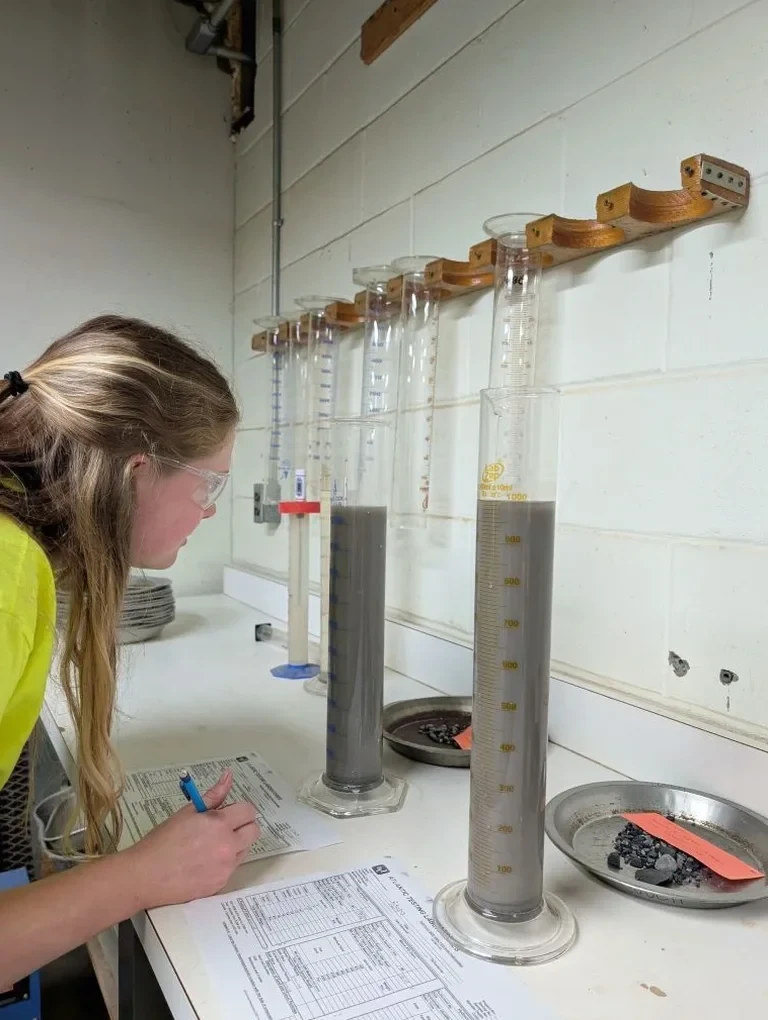
Local geotechnical conditions in Tampa Florida
Per ASTM D1883 and FDOT Standard Specifications Section 160, subgrade acceptance on Florida Department of Transportation projects requires CBR values that meet minimum thresholds for the design traffic level. In Tampa, where the underlying Hawthorne Formation can produce pockets of plastic clay within predominantly sandy profiles, assuming a uniform CBR across the site is a gamble pavement engineers learn not to take. A single low-CBR zone that goes undetected becomes a localized pavement failure within two or three wet-dry cycles, especially under the heavy truck traffic on arterial roads like Dale Mabry Highway or I-275 feeder routes. The risk compounds when contractors attempt to use on-site sandy soils without stabilization; material that looks competent in the borrow pit can drop below 6 percent CBR after saturation, triggering the need for chemical stabilization or a thicker aggregate base. Early laboratory testing during the design phase, with samples taken from each distinct soil unit identified in the geotechnical investigation, eliminates the expensive alternative of reconstructing failed pavement sections after the project is complete.
Our services
Our Tampa laboratory supports pavement design projects across Hillsborough, Pinellas, and Pasco counties with CBR testing programs tailored to the material type and project specification. Each program includes compaction testing to establish the molding moisture and density relationship before CBR specimens are prepared.
Soaked CBR (ASTM D1883)
The standard for Florida pavement design. Specimens are compacted at optimum moisture and soaked for 96 hours with surcharge weights to simulate field saturation. Reported at 0.1-inch and 0.2-inch penetration, with swell measurements recorded during soaking.
Unsoaked CBR
Used for free-draining materials or when project specifications only require immediate bearing ratio. Specimens are compacted and tested at the molding moisture content without a soaking period. Applicable to limerock bases that maintain strength above the water table.
CBR with Lime-Rock Testing
Tampa-area projects frequently use locally quarried limerock for base courses. We test reshaped limestone materials per FDOT gradation requirements, compacted at modified Proctor effort, to verify bearing ratios meet or exceed the 100 percent CBR minimum typically specified for limerock stabilized subgrade.
Common questions
What does a laboratory CBR test cost in Tampa?
A single-point soaked CBR test, including the required compaction curve, typically runs between US$140 and US$230 per specimen in the Tampa market. A full three-point CBR program with compaction curve, three molded specimens, and the 96-hour soak period provides the design envelope most engineers need and pricing reflects the number of compaction points and whether modified Proctor effort is required for limerock materials.
Why is the 96-hour soak necessary for Tampa subgrade soils?
Tampa's shallow groundwater table, typically within 3 to 6 feet of the surface in much of the city, combined with nearly 50 inches of annual rainfall, means subgrade soils will experience prolonged saturation during the pavement's service life. The 96-hour soak per ASTM D1883 simulates that worst-case condition. Sandy soils common in Hillsborough County, particularly A-3 and A-2-4 materials, can lose 40 to 60 percent of their bearing capacity when saturated, so the soaked CBR value provides the conservative basis for pavement thickness design that prevents premature rutting and cracking.
What CBR value is required for residential streets versus arterial roads in Tampa?
FDOT and Hillsborough County standards typically require a minimum soaked CBR of 6 to 8 percent for low-volume residential streets with light traffic. Arterial and collector roads with higher truck volumes generally need subgrade or stabilized subgrade with CBR values of 10 percent or greater. When native sandy soils test below these thresholds, the standard approach is chemical stabilization with cement or lime, or increasing the aggregate base thickness to distribute loads over the weaker subgrade. The design CBR value directly controls the structural number and pavement layer thicknesses in the AASHTO 1993 design method still widely used in Florida.